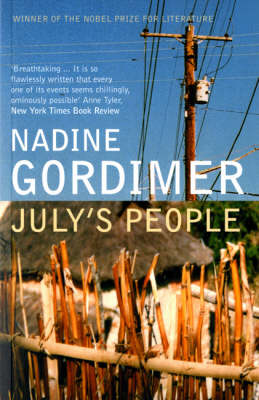
Nadine Gordimer (1923-)
The narrative begins in chaos. Jumping from past and present, weaving between characters' thoughts and memories. As South African apartheid begins to unravel, the tenuous societal structure collapses, as does the identity of Maureen and Bam Smales. The tension and unrest turns to riots, the Smales have fled with their faithful servant of 15 years, July, to his home in the bush. As the family is displaced, with only seconds to flee and without time to pack, Bam grabs a gun while his wife grabs a few coveted rolls of toilet paper and in their chosen items they begin to reveal their prejudices. For Bam, the assumption is that July's people could be dangerous. The gun not only provides a sense of protection, but as he is stripped of his authority it asserts a sense of power that he is otherwise incapable of possessing. For Maureen, the assumption is that July's people are primitive and dirty. As she tries to retain a sense of order, a sense of the way things were, she is caught in the interstices between the reality of their new existence and her perception of who she is.
Both Maureen and Bam would have previously considered themselves liberals. They weren't racist or prejudiced. This war, this uprising, it wasn't their fight. They didn't profess to belong to the superior race, or rather they didn't proselytize their superiority. "They had fled the fighting in the streets, the danger for their children, the necessity to defend their lives in the names of ideals they didn't share in a destroyed white society they didn't believe in..." They treated their servants with respect, if not dignity...and yet here in the bush, surrounded by deprivation, slowly their world is turned upside down and they realize that their role as "master," now taken away, has left a vapid hole and exposed a subterranean prejudice they must fight and contend with as they try to come to terms with the ambiguities of their new life in their isolated surroundings.
For their safety the Smales must remain in the village, and they find themselves in the uncomfortable position of being completely dependent on July for their survival. July takes the car and disappears and for the first time Bam and Maureen are untethered. They are no longer masters of their sole possession and only means of escape. When July returns, bringing them supplies, they are unable to assert their authority and are powerless to impose their will. For the first time it is July who makes decisions and determines their needs. Bam, stripped of his authority, unable to provide for his family is completely emasculated. He attempts to regain his footing, and with the "white man's face, the old, sardonic, controlled challenge of the patron" he demands to know where and why July took their car. But the threats fall flat. July was out, attending to their needs as he had for the last 15 years. Although they could ask him to return the keys of the car, they don't, and July slowly begins to wear the mantle of authority they have so recently been stripped of.
Maureen attempts to retrieve the keys from July. She wants him to give them to her without having to ask for them. She tells July she wants the rubber floor mat from the car and puts outs her hand, not a request, but an assumption. When she realizes she must give them back, she wanders toward July's hut and waits for him to come to her for their tete a tete.
"When he appeared he was merely coming over to her, unhurried, on a sunny day. Nothing sullen or resentful about him; her little triumph in getting him to come turned over inside her with a throb and showed the meanness of something hidden under a stone."
She asks him whether or not they treated him well, she needs his affirmation, she needs to hear that they gave him everything that he needed, that they treated him fairly, but instead he begins to expose the traces of meanness that have existed all along in the mistrustful glances. He has been their "boy" whether or not they acknowledge the fact. Maureen, hurt by the biting truth of his remarks, threatens to expose his unfaithfulness to his wife. But while her victory gives her a small sense of empowerment, it strips what little is left of her own dignity.
What bothers the Smales most isn't July's independence, but the uncovering and exposing of a version of racism they never expected to find. The version that pays servants always and on time, but refuses to allow the luxury of their own sitting room for fear it will always be crowded with unwanted visitors. The version that provides their servant with a bedroom apartment, but only a single chair to further discourage guests. The version that controls every aspect of July's life as a rite, a subtle almost invisible form of ownership. As they struggle to come to terms with these oscillating emotions they regard each other with disgust.
The subtle brilliance of this book is that rather than having a family of racists learn the value and humanity of the natives they are are forced to live among, instead a family of liberals must contend with the demons of racism heretofore unexpected, leaving them conscious stricken and unfamiliar.
Monday, May 13, 2013
Friday, May 3, 2013
The Song of Roland
The Song of Roland recounts the Battle of Roncesvalles in 778 in a style that would put Quentin Terantino to shame and was probably written for a similar target demographic. Claimed to be the oldest surviving work of French literature, this epic poem depicts the betrayal of the Franks and their subsequent battle to victory.
The poem begins "Charles the king, our mighty emperor has been in Spain for all of seven years.." at this point all pagan nations from France to the sea have been conquered, all but the mountain city, Saragossa. "Marsilla holds it; he does not love God, but serves Mohammed and invokes Apollo. No matter what he does, his ruin will come." An inauspicious beginning for the Saracens.
Charlemagne and his men are exhausted from battle and apprehensive about the size of the Saracen army and decides to send an envoy to ascertain whether or not this last bastion of pagans will throw in the towel and convert to Christianity. As Charlemagne ponders whom to send on this somewhat dangerous mission, his lords and barons seem hesitant to claim such a mission for themselves, and then the much lauded Roland decides to nominate his stepfather...much to the stepfather, Ganelon's, chagrin. Ganelon is enraged. As he musters his courage and gathers his gear the hatred drips off his brow. "His arrogance will be the end of him, for every single day he teases death. If someone killed him...we might all have peace." And thus the germ of an idea is planted, and Ganelon ruminates, chewing the cud of his idea as he makes his way to meet Marsilla, he promises under his breath that he will see to it that Roland dies.
As Ganelon is presented to Marsilla he paints Charlemagne's demands as unglamorously as possible. " Thus noble Charlemagne requires of you that you receive the holy Christian faith, and he will give you half of Spain in fief." Obviously Marsilla is insulted, growing colorless with rage he is about to strike Ganelon, when he is told this messenger might not have France's best interests at heart. After a short tete a tete, Genelon has told the Saracen's how they can ambush the rear guard of Charlemagne's army and as a bonus kill Roland in the process. Charlemagne will be so distraught over losing his nephew, that he will have no desire to ever fight again.
"If someone were to cause the death of Roland, then Charles would lose the right arm from his body; the awe-inspiring host would cease to be, no more would Charles assemble such a force and Tere Majur would then be left in peace..."
It doesn't exactly go according to plan and Ganelon officially has become the worlds worst stepfather. Although the Franks are ambushed, they fight so valiantly they are able to do considerable damage to the Saracen army. Rather than risk any remote possibility of cowardice, Roland refuses to blow his olifant and call for help..."May God forbid that it be said by any man alive I ever blew my horn because of pagans..."
There might be a tiny bit of confusion between bravery and bravado and after receiving a little lecture from Olivier regarding prudence and recklessness, Roland decides they have lost enough men, there is no hope for the rear guard, but if Charlemagne would come with all his army to defend their honor and avenge their name, they would certainly be victorious. Roland blows his olifant, bursting his temples and continues to fight until he is the last man standing. Slowly he crawls to a hill, attempts to destroy his sword so that it won't fall into the hands of the pagans and then as he leans himself against a tree facing the enemy he dies, even in death not turning his back on his oppressors.
When Charlemagne finally arrives, he finds only the dead bodies of even his most valiant soldiers. The Franks arms themselves and pursue the fleeing Saracen army, chasing them into the Ebro river where they drown en masse.
Some of the more horrific Terantino-esque moments were: "He breaks his gilt, fleuron-emblazoned shield, bursting both his eyeballs from his head- his brain comes tumbling downward to his feet -..." or "the count swings down with such tremendous force , he shears away his helmet to the nasal and slashes through his nose and mouth and teeth, his trunk and through his coat of jazeraint, his gilded saddle, both its silver bows and deep into the backbone of his horse..." YIKES!
I also thought the blatant propaganda was interesting. Each time a pagan dies, Satan is waiting near by to drag his spirit into hell unlike the lucky Franks who not only have St. Michael and the angel Gabriel fighting for them, but they are all guaranteed a seat in Holy Paradise next to the Innocents. While the Saracens are presented as cowards, fleeing and screaming "we can't take any more!" The Franks dutifully and gloriously follow in pursuit.
While a little heavy in the skull crushing department, I found this poem vastly more engrossing than Beowulf...and I now, like Charlemagne and all his army can cry "Monjoy" when charging the enemy into battle, something I'm sure will come in handy one of these days.
The poem begins "Charles the king, our mighty emperor has been in Spain for all of seven years.." at this point all pagan nations from France to the sea have been conquered, all but the mountain city, Saragossa. "Marsilla holds it; he does not love God, but serves Mohammed and invokes Apollo. No matter what he does, his ruin will come." An inauspicious beginning for the Saracens.
Charlemagne and his men are exhausted from battle and apprehensive about the size of the Saracen army and decides to send an envoy to ascertain whether or not this last bastion of pagans will throw in the towel and convert to Christianity. As Charlemagne ponders whom to send on this somewhat dangerous mission, his lords and barons seem hesitant to claim such a mission for themselves, and then the much lauded Roland decides to nominate his stepfather...much to the stepfather, Ganelon's, chagrin. Ganelon is enraged. As he musters his courage and gathers his gear the hatred drips off his brow. "His arrogance will be the end of him, for every single day he teases death. If someone killed him...we might all have peace." And thus the germ of an idea is planted, and Ganelon ruminates, chewing the cud of his idea as he makes his way to meet Marsilla, he promises under his breath that he will see to it that Roland dies.
As Ganelon is presented to Marsilla he paints Charlemagne's demands as unglamorously as possible. " Thus noble Charlemagne requires of you that you receive the holy Christian faith, and he will give you half of Spain in fief." Obviously Marsilla is insulted, growing colorless with rage he is about to strike Ganelon, when he is told this messenger might not have France's best interests at heart. After a short tete a tete, Genelon has told the Saracen's how they can ambush the rear guard of Charlemagne's army and as a bonus kill Roland in the process. Charlemagne will be so distraught over losing his nephew, that he will have no desire to ever fight again.
"If someone were to cause the death of Roland, then Charles would lose the right arm from his body; the awe-inspiring host would cease to be, no more would Charles assemble such a force and Tere Majur would then be left in peace..."
It doesn't exactly go according to plan and Ganelon officially has become the worlds worst stepfather. Although the Franks are ambushed, they fight so valiantly they are able to do considerable damage to the Saracen army. Rather than risk any remote possibility of cowardice, Roland refuses to blow his olifant and call for help..."May God forbid that it be said by any man alive I ever blew my horn because of pagans..."
There might be a tiny bit of confusion between bravery and bravado and after receiving a little lecture from Olivier regarding prudence and recklessness, Roland decides they have lost enough men, there is no hope for the rear guard, but if Charlemagne would come with all his army to defend their honor and avenge their name, they would certainly be victorious. Roland blows his olifant, bursting his temples and continues to fight until he is the last man standing. Slowly he crawls to a hill, attempts to destroy his sword so that it won't fall into the hands of the pagans and then as he leans himself against a tree facing the enemy he dies, even in death not turning his back on his oppressors.
When Charlemagne finally arrives, he finds only the dead bodies of even his most valiant soldiers. The Franks arms themselves and pursue the fleeing Saracen army, chasing them into the Ebro river where they drown en masse.
Some of the more horrific Terantino-esque moments were: "He breaks his gilt, fleuron-emblazoned shield, bursting both his eyeballs from his head- his brain comes tumbling downward to his feet -..." or "the count swings down with such tremendous force , he shears away his helmet to the nasal and slashes through his nose and mouth and teeth, his trunk and through his coat of jazeraint, his gilded saddle, both its silver bows and deep into the backbone of his horse..." YIKES!
I also thought the blatant propaganda was interesting. Each time a pagan dies, Satan is waiting near by to drag his spirit into hell unlike the lucky Franks who not only have St. Michael and the angel Gabriel fighting for them, but they are all guaranteed a seat in Holy Paradise next to the Innocents. While the Saracens are presented as cowards, fleeing and screaming "we can't take any more!" The Franks dutifully and gloriously follow in pursuit.
While a little heavy in the skull crushing department, I found this poem vastly more engrossing than Beowulf...and I now, like Charlemagne and all his army can cry "Monjoy" when charging the enemy into battle, something I'm sure will come in handy one of these days.
Monday, April 29, 2013
The Master and Margarita - Mikhail Bulgakov
The aftermath of Stalin's regime left a trail of destruction in its wake, both structurally and psychologically; although Bulgakov finished writing The Master and Margarita in the 1940's it wasn't officially published until the 1960's when The Era of Stagnation under Brezhnev was just beginning, creating an atmosphere of vapidity that made an interesting counterpoint to Bulgakov's novel. Under Stalin, Russian life was filled with a grim sense of helplessness and unpredictability, friends and family were encouraged to report unpatriotic behavior on their loved ones, neighbors would accuse neighbors of anything simply to be able to take over another room and expand their apartments; the climate under Stalin was filled with suspicion and dread. At any moment a loved one could disappear into the Gulag Archipelago, perhaps never to be seen or heard from again.
In 1946, the Soviet Union passed the Zhdanov Doctrine, dividing the world into two camps, that of the imperialistic world headed by the United States, and the democratic, headed by the Soviet Union. The main principle of the Zhdanov Doctrine was summarized by the phrase "The only conflict that is possible in Soviet culture is the conflict between good and best." Meaning, that for Soviet artists and writers and the intelligentsia they could either conform to the party line or they would suffer the repercussions...
The Master and Margarita follows three interwoven narratives. The first being that Professor Woland (i.e. Satan) and his retinue and the havoc they reek on Moscow. It is a satire of the demonic vs. the literary powers and the imposed normalcy of Soviet life under the Great Terror of the 1930's. The professor is introduced interrupting a discussion between a poet and an editor that work for a Soviet anti-religious propaganda magazine, they are disputing the existence of Christ. Woland, who saunters up holding a cane with the head of a poodle, (one of the many references to Faust's Mephistopheles) after a few pleasantries begins to dismantle their arguments against the plausibility of the Christ story and the existence of God. As a representative of the "other world" Woland argues that God must exist, without heaven there can be no hell, or rather God exists because the evidence of Satan is inarguable. He then begins his foray into Muscovite life, upending the predictable and followed by a posse of buffoons reeking havoc and disorder on all they come into contact with, specifically the literati.
One of Woland's arguments for the Christ story, is that he was there, so therefor it must have happened; an argument that tends to confirm the suspicion of his insanity rather than the veracity of his theory. He then begins a narration about Pontius Pilate, thus introducing us to the second narrative. The Pontius Pilate narrative hinges on one of Bulgakov's aphorisms, "Cowardice is the most terrible of vices.." Arguing that it was simply cowardice that caused Pilate to agree to the death sentence for Yeshua, who seemed little more than a pacifistic philosopher. Although neither Stalin or Caesar make appearances in the narrative in person, they are omnipresent in their imposed inarguable will that has become the measure of morality and the construct of reality. During his brief encounter with Yeshua, Pilate becomes certain that this man, while perhaps possessing some supernatural power, is not harmful in the slightest. But when Yeshua says something that does not conform to the party line :
"Among other things", the prisoner recounted, "I said that all authority is violence over people, and that a time will come when there will be no authority of the Caesars, nor any other authority. Man will pass into the kingdom of truth and justice, where generally there will be no need for any authority."
Pilate, after hearing this blasphemy against party doctrine, has no choice but to hand Yeshua over to be murdered, while a murderer, Barabbas, is released to go free. Apparently murder is less of a threat than controversial philosophies. After Yeshua is led away to be crucified, Pilate is overcome with the shame of his cowardice. He must then spend two thousand years in limbo reliving his shame and muttering the same mantra under his breath over and over again.
"He says that even the moon gives him no peace, and that his is a bad job. That is what he always says when he is not asleep, and when he sleeps he dreams one and the same thing: there is a path of moonlight, and he wants to walk down it and talk with the prisoner Ha-Nozri, because, as he insists, he never finished what he was saying that time, long ago, on the fourteenth day of the spring month of Nisan. But alas, for some reason he never manages to get on to this path, and no one ever comes to him. Then there's no help for it, he must talk to himself."
The third narrative is about the writer, representing the intelligentsia, responsible for writing truth and upholding the triumph of poetry, imagination and the free world over the terror of oppression. This writer, the master, has been struggling with a manuscript about Pontius Pilate for years, he has begun over and over and has finally been driven to madness, leaving all he has behind him, including the beautiful Margarita, his helpmate and companion. He has checked himself into an asylum, where he waits for the confidence to challenge the rule of terror that has strangled the artists and writers around him, he waits in limbo for his salvation.
The characters of the Master and Margarita are based on Bulgakov and his second wife, Elena Sergeevna, who like Margarita, was married to a high ranking official. Elena and Margarita encourage the writers to survive, they believe in them and in the importance of their work. While the master is hidden away in the asylum, Margarita makes a bargain with Satan in order to find the master and restore him to his little basement where they have spent many countless hours together working on their manuscript, for it is as much hers as it is his. Margarita is the true heroine of this book, representing true love and personal courage, willing to defy everything that comes between her and the master, whether it is societal conventions, party politics or the constrictions of reality. She embarks on a journey into the bowels of hell, becomes the Queen of Satan's ball and must give up her identity, as she is stripped of her own being in exchange for the body of a witch, and all this to pursue the master, so that she might help him to finish his story and find rest.
When finally, Woland has agreed to give both the master and Margarita peace, he takes them on a journey where they must first leave all that they are and have behind and that culminates with the meeting of the object of the master's obsession, Pilate.
"The master seemed to have been expecting this, as he stood motionless and looked at the seated procurator he cupped his hands to his mouth and cried out so that the echo leaped over the unpeopled and unforested mountains: "You're free! You're free! He's waiting for you!"
Releasing Pilate from his two thousand years in limbo to finally finish his discussion with the philosopher, while simultaneously discovering peace for himself in limbo where the artist will finally be free, surrounded by the stillness and peace not granted to him in life.
Tuesday, April 16, 2013
100 Years of Solitude - Gabriel García Márquez
The book opens with this line:
"Many years later, as he faced the firing squad, Colonel Aureliano Buendia was to remember that distant afternoon when his father took him to discover ice."
And a family tree on the other side of the page, a foreboding and tangled lineage that I went back to over and over again until I gave up, threw in the towel and realized the specific characters are secondary to the plot.
At once the reader is pulled into another universe of magical realism, where women disappear into the heavens wrapped in bed sheets. I was immediately drawn into this world, where in an attempt to find a new world and leave their past behind them, Jose Arcadio Buendia and his wife Ursula, leave everything they have ever know to travel through virgin territory and finally after having a vision of a city of mirrors that would reflect the world in and about it, they found Macando at the riverside of a wandering jungle.
The narrative constantly shifts from past to present and as more and more generations are introduced all with confusing matrilineage I began to feel like I was reading something better written but slightly less interesting then a genealogy record. Magical realism sometimes makes me uncomfortable, nothing is stable or predictable and like a Murakami novel fish could start raining from the sky at any moment. As a reader this requires a lot of trust, and after 200 pages or so I stopped fighting it and let the world of Macando sweep me into its reality. By the last 50 pages I couldn't put it down and was hoping it would never end. I wanted to crawl into Macando and never leave, walk down its muddy streets and go door to door with Arcadio soliciting raffle tickets for broken hopes and impossible dreams.
The basic summation of the plot is that the same people are born over and over again as the family slowly devolves and what is left of their hopes and dreams lies shriveled and naked and slowly carried away by a procession of ants...
While the family struggles to keep up appearances, generations have passed and the family lacks the grandeur it once possessed.
"Sitting at the head of the table, drinking a chicken broth that landed in her stomach like an elixir of resurrection, Meme then saw Fernanda and Amaranta wrapped in an accusatory halo of reality. She had to make a great effort not to throw at them their prissiness, their poverty of spirit, their delusions of grandeur."
Each family member embarks on their own solitary crusade, whether it is the constant fight to keep the weeds from devouring the house and the ants from tearing down the foundation of their lives, or a hopeless political battle between the liberals and conservatives who no longer remember why they're fighting, or a special smoldering hatred for one and love for another, the characters pick up their crosses and fight their battles alone.
"At times it pained her to have an outpouring of misery follow its course, and at times it would make her so angry that she would prick her fingers with the needles, but what pained her most and enraged her most and made her the most bitter was the fragrant and wormy guava grove of love that was dragging her toward death....
...The world was reduced to the surface of her skin and her inner self was safe from all bitterness. It pained her not to have had that revelation many years before when it had still been possible to purify memories and reconstruct the universe under a new light and evoke without trembling Pietro Crespi's smell of lavender at dusk and rescue Rebeca from her slough of misery, not out of hatred or love but because of the measureless understanding of solitude."
While each generation attempts to conquer their own individual ineffectual demons, they are overwhelmed with the isolation of their crusades and confronted with the futile lack of progress. When the family finally produces a bastard they are ashamed of (vs. all the other children in the family with a less then glamorous pedigree) they lock Aureliano Babilonia in the room filled with cryptic parchments and he spends his life slowly attempting to decipher them only to finally realize they are a prophetic history of every moment his family has ever lived and will live. Their lives have been written from the beginning only to end in a crumbling destruction, abandoned by fate.
"What did you expect?" he murmured. "Time passes."
"That's how it goes," Ursula said, "but not so much."
When she said it she realized that she was giving the same reply that Colonel Aureliano Buendia had given in his death cell, and once again she shuddered with the evidence that time was not passing, as she admitted, but that it was turning in a circle."
The Viconian theory of cyclic history consists of three recurring phases, a primitive phase of society embedded with the Divine or mythic, a phase of political conflict and finally an egalitarian phase where rank and privilege have been dismantled by the previous conflicts. Marquez creates a world where history is repetitive in a similar fashion. The family starts out with little besides the clothes on their backs as they forage through the jungle, intent on making a new life for themselves. As generations pass the family becomes embroiled in the politics not only of Macando but in the regions surrounding them, forcing a peaceful, idyllic town into the demands of modernity and finally when the dust settles, the town no longer remembers the founders existence, they themselves have become the myth. The moment when Aureliano Babilonia realizes that not only is history repetitive but also predetermined is the moment the Buendia family history comes to an end.
"Before reaching the final line, however, he had already understood that he would never leave the room, for it was already foreseen that the city of mirrors (or mirages) would be wiped out by the wind and exiled from the memory of men...everything written on the parchments was unrepeatable since time immemorial and forever more, because races condemned to one hundred years of solitude did not have a second opportunity on earth."
Sunday, March 17, 2013
Summer and Smoke - Tennessee Williams
Tennessee Williams (1911-1983)
The play opens with our young heroine, Alma, sitting by a fountain. She is quick to tell the audience the derivation of her name, in Spanish Alma means soul, and she is the very embodiment of her name, light and airy, not quite a part of a social set instead she floats just above them, accused of putting on airs with fine pronunciations and affected speech. She is a preachers daughter and as such is presented as a champion of extreme moralism and propriety.
A young boy creeps onto the stage, shooting a pea-shooter at Alma's bent over back and as she utters a shocked cry of horror and whirls about he laughs, an impish, mischievous boy who has evidently had a runny nose. Much to his embarrassment, Alma has made him handkerchiefs and put them on his desk at school.
John: "Are you trying to make a fool of me?"
Alma: "You have a bad cold and your nose has been running all week. It spoils your appearance."
Her evident love for the boy is of the variety that always sees the potential of the lover without recognizing the immediacy of who he is, always seeing who he can become rather than what he is now. She describes this almost as a type of spiritual love. A love that waits and hopes. Constantly throughout the Prologue she describes ways for his improvement, "I was only thinking how handsome you'd be if your face wasn't dirty.." and so on, while John after finally taking a handkerchief and wiping his face tries to convince her to kiss him. She turns away, young and afraid of such presumptions, he steals a kiss anyway and then pulling her hair ribbon as a crescendo runs off with a mocking laugh.
As the play progresses, Alma and John have grown up, Alma now although in her early 20's is prematurely spinsterish with a touch of the neurotic. John, who is following in his father's footsteps in the pursuit of a medical degree, has not lost his predilection for chasing girls, although he no longer stops at stealing a kiss. As they meet at the same fountain from years before, during a summer festival, Alma doesn't lose a beat, she once again begins to perseverate on how John can better himself from his sullied reputation as a wild, disreputable young man. Her faith in what he could be is somewhat exhausting and he retaliates by first diagnosing her with a "doppleganger," a prognosis that horrifies Alma, who begs to know if it's a serious condition, and secondly by telling her of the reputation she has made for herself, one of a pretentious goody-two-shoes...Her feelings are obviously hurt and to make up for his somewhat harsh comments he offers to take her driving, but mid sentence sees Rosa Gonzales, a dazzling flirtatious beauty, and in a flash he leaves her alone by the fountain in the pursuit of something other than scholastics.
As the play continues, Alma becomes more and more obsessed with the person she's created and John becomes more and more the unruly philandering type he originally gravitates toward, culminating in a shoot out of sorts, a broken engagement with Rosa and the death of his father. Alma, pines away wondering why the love of her soul resists being so.
Finally after being jaded and disillusioned, in a shocking turn of events (that seems less shocking and more of just a tired plot twist) Alma propositions John. She no longer believes in love of a spiritual sort, and questions the veracity of the soul. She is tired of her stringent hold on morality and wants to throw it away in exchange for animalistic passion.
"...now I have changed my mind, or the girl who said "no" - she doesn't exist any more, she died last summer, suffocated in smoke from something on fire inside her..."
...But now John believes in true love of a pure and spiritual sort...only he's found it in another young woman and to make matters worse, this young woman was once Alma's singing pupil, Nellie. She has effectively been exchanged for a younger model! She retires, tired, jaded, exhausted back the fountain and waits for the first traveling salesman to debark from the nearby train depot. When one finally makes his way toward her she strikes up a conversation about the temperature of the fountain water before suggesting they make their way to the casino to partake of whatever pleasures present themselves, a request she had earlier refused from John, and as she follows the salesman to his car, she has taken the place of Nellie's mother as the loose woman who spends her days waiting by the fountain in the hopes of encounters with strangers, the tangible exchange of bodies being the only form of communication left that she can understand.
The play opens with our young heroine, Alma, sitting by a fountain. She is quick to tell the audience the derivation of her name, in Spanish Alma means soul, and she is the very embodiment of her name, light and airy, not quite a part of a social set instead she floats just above them, accused of putting on airs with fine pronunciations and affected speech. She is a preachers daughter and as such is presented as a champion of extreme moralism and propriety.
A young boy creeps onto the stage, shooting a pea-shooter at Alma's bent over back and as she utters a shocked cry of horror and whirls about he laughs, an impish, mischievous boy who has evidently had a runny nose. Much to his embarrassment, Alma has made him handkerchiefs and put them on his desk at school.
John: "Are you trying to make a fool of me?"
Alma: "You have a bad cold and your nose has been running all week. It spoils your appearance."
Her evident love for the boy is of the variety that always sees the potential of the lover without recognizing the immediacy of who he is, always seeing who he can become rather than what he is now. She describes this almost as a type of spiritual love. A love that waits and hopes. Constantly throughout the Prologue she describes ways for his improvement, "I was only thinking how handsome you'd be if your face wasn't dirty.." and so on, while John after finally taking a handkerchief and wiping his face tries to convince her to kiss him. She turns away, young and afraid of such presumptions, he steals a kiss anyway and then pulling her hair ribbon as a crescendo runs off with a mocking laugh.
As the play progresses, Alma and John have grown up, Alma now although in her early 20's is prematurely spinsterish with a touch of the neurotic. John, who is following in his father's footsteps in the pursuit of a medical degree, has not lost his predilection for chasing girls, although he no longer stops at stealing a kiss. As they meet at the same fountain from years before, during a summer festival, Alma doesn't lose a beat, she once again begins to perseverate on how John can better himself from his sullied reputation as a wild, disreputable young man. Her faith in what he could be is somewhat exhausting and he retaliates by first diagnosing her with a "doppleganger," a prognosis that horrifies Alma, who begs to know if it's a serious condition, and secondly by telling her of the reputation she has made for herself, one of a pretentious goody-two-shoes...Her feelings are obviously hurt and to make up for his somewhat harsh comments he offers to take her driving, but mid sentence sees Rosa Gonzales, a dazzling flirtatious beauty, and in a flash he leaves her alone by the fountain in the pursuit of something other than scholastics.
As the play continues, Alma becomes more and more obsessed with the person she's created and John becomes more and more the unruly philandering type he originally gravitates toward, culminating in a shoot out of sorts, a broken engagement with Rosa and the death of his father. Alma, pines away wondering why the love of her soul resists being so.
Finally after being jaded and disillusioned, in a shocking turn of events (that seems less shocking and more of just a tired plot twist) Alma propositions John. She no longer believes in love of a spiritual sort, and questions the veracity of the soul. She is tired of her stringent hold on morality and wants to throw it away in exchange for animalistic passion.
"...now I have changed my mind, or the girl who said "no" - she doesn't exist any more, she died last summer, suffocated in smoke from something on fire inside her..."
...But now John believes in true love of a pure and spiritual sort...only he's found it in another young woman and to make matters worse, this young woman was once Alma's singing pupil, Nellie. She has effectively been exchanged for a younger model! She retires, tired, jaded, exhausted back the fountain and waits for the first traveling salesman to debark from the nearby train depot. When one finally makes his way toward her she strikes up a conversation about the temperature of the fountain water before suggesting they make their way to the casino to partake of whatever pleasures present themselves, a request she had earlier refused from John, and as she follows the salesman to his car, she has taken the place of Nellie's mother as the loose woman who spends her days waiting by the fountain in the hopes of encounters with strangers, the tangible exchange of bodies being the only form of communication left that she can understand.
Friday, February 15, 2013
The Mosquito Coast - Paul Theroux
Paul Theroux (1941-)
A cross between the Swiss Family Robinson and Glass Castles, Mosquito Coast is what would have been if Mr. Robinson was a paranoid psychotic inventor. The story follows the Fox family as they uproot from their small home in Massachusetts to find a happier and simpler life in the backwaters of Honduras.
The book opens with the father, Allie Fox, lecturing his 13 year old son, Charlie, about the downfall of the American lifestyle. Allie is an irascible and brilliant inventor, never short for words and quick to give a lecture. A Harvard dropout, a self taught engineer who demands perfection and has little time for religion, consumerism or poor craftsmanship. As they collect items for one of Allie's inventions, Charlie holds his father in a sort awe and reverence. Although he wishes he could participate in the normal everyday American childhood that he observes around him, instead Charlie and his 3 younger siblings live a sheltered and secluded life as their father tries to protect them from conspicuous consumption and the corruption of a capitalist society.
Eventually Allie decides he has had enough and uproots his family, they leave taking only the barest of necessities, seeds, tools and camping supplies, abandoning everything else, anything that could remind them of the life they are leaving behind. From that moment the word "home" is forbidden, they are turning their backs on the past and all they have left behind as they make their way into the impenetrable wilderness. Only Allie knows where they are headed and the family clings to him, dependent on him for their survival in a hopeful and trusting way. As they begin to construct their new life hidden deep within the jungle of Honduras, all Allie's ingenuity and brilliance seems like a self fulfilling prophecy. Within a short time they have created an idyllic oasis and as Allie continues to invent, the children rest in the security of the strength and indefatigably of their father.
And then one day their life is turned upside down and they must struggle to survive, struggle to maintain hope as their lives are caught in a slowly eroding tailspin. Allie, who although quirky, seemed generally sane, begins to exhibit more and more signs of paranoia, his unending lectures are tinged with a sense of the deranged and as the family picks up the pieces of their increasingly shattered life, they must come to terms with their fathers weakening grasp of reality.
I haven't cried while reading a book in a long time... (although Sam Shepard made me want to cry for entirely different reasons...)Theroux's writing style is deeply engaging, I felt like I was living in the jungle, feeling the torpid summer heat, hearing the never ending drone of the mosquitoes...feeling the hope of a new life and the constant disappointments...as Charlie realizes his father is no longer sane he must decide how to save the family from their father's increasingly drastic demands.
"Then the darkness, which was like fathoms of ink, softened, became finely gray, and, without revealing anything more of the sea, turned to powder. All around us the powdery dawn thickened, until, growing coarser and ashy, in a sunrise without sun, it threw us glimpses of the soapy sea and the shoreline and the jungle heaped like black rags of kelp. Soon the sun was an hour high on the naked shore."
A cross between the Swiss Family Robinson and Glass Castles, Mosquito Coast is what would have been if Mr. Robinson was a paranoid psychotic inventor. The story follows the Fox family as they uproot from their small home in Massachusetts to find a happier and simpler life in the backwaters of Honduras.
The book opens with the father, Allie Fox, lecturing his 13 year old son, Charlie, about the downfall of the American lifestyle. Allie is an irascible and brilliant inventor, never short for words and quick to give a lecture. A Harvard dropout, a self taught engineer who demands perfection and has little time for religion, consumerism or poor craftsmanship. As they collect items for one of Allie's inventions, Charlie holds his father in a sort awe and reverence. Although he wishes he could participate in the normal everyday American childhood that he observes around him, instead Charlie and his 3 younger siblings live a sheltered and secluded life as their father tries to protect them from conspicuous consumption and the corruption of a capitalist society.
Eventually Allie decides he has had enough and uproots his family, they leave taking only the barest of necessities, seeds, tools and camping supplies, abandoning everything else, anything that could remind them of the life they are leaving behind. From that moment the word "home" is forbidden, they are turning their backs on the past and all they have left behind as they make their way into the impenetrable wilderness. Only Allie knows where they are headed and the family clings to him, dependent on him for their survival in a hopeful and trusting way. As they begin to construct their new life hidden deep within the jungle of Honduras, all Allie's ingenuity and brilliance seems like a self fulfilling prophecy. Within a short time they have created an idyllic oasis and as Allie continues to invent, the children rest in the security of the strength and indefatigably of their father.
And then one day their life is turned upside down and they must struggle to survive, struggle to maintain hope as their lives are caught in a slowly eroding tailspin. Allie, who although quirky, seemed generally sane, begins to exhibit more and more signs of paranoia, his unending lectures are tinged with a sense of the deranged and as the family picks up the pieces of their increasingly shattered life, they must come to terms with their fathers weakening grasp of reality.
I haven't cried while reading a book in a long time... (although Sam Shepard made me want to cry for entirely different reasons...)Theroux's writing style is deeply engaging, I felt like I was living in the jungle, feeling the torpid summer heat, hearing the never ending drone of the mosquitoes...feeling the hope of a new life and the constant disappointments...as Charlie realizes his father is no longer sane he must decide how to save the family from their father's increasingly drastic demands.
"Then the darkness, which was like fathoms of ink, softened, became finely gray, and, without revealing anything more of the sea, turned to powder. All around us the powdery dawn thickened, until, growing coarser and ashy, in a sunrise without sun, it threw us glimpses of the soapy sea and the shoreline and the jungle heaped like black rags of kelp. Soon the sun was an hour high on the naked shore."
Thursday, February 7, 2013
La Turista - Sam Shepard
La Turista was as inaccessible a play as I've come to expect from Sam Shepard...I was left with the feeling that I was drastically missing something...upon further research I find I am not alone and rather than being willfully obtuse and making no effort to be sympathetic to his writing style..I can shift some of the blame to Shepard himself. Because there is no context to this play it takes quite a bit of sleuthing about to begin to uncover any semblance of a coherent, meaningful plot. Visiting Shepard's website I found this completely unhelpful synopsis:
"Two-act play. A chronicle of the experiences of two unpleasant Americans, holed up in Mexico with ‘la turista’ (traveller’s diarrhea). Salem and Kent are two deeply unlikeable travelers, possessed of a characteristic combination of helplessness and arrogance, who are getting further and further out of their depth in a bleak and incoherent world. As the play proceeds, and their desperation grows, they enlist the help of increasingly weird strangers to purge themselves of their sickness."
...really? That's it? In a 1967 review by Helen Easton from the New York Review of Books, she says:
Although the play has power, I do not consider it a good play. However, the superb acting and the desire to see whether the second part would clarify the first part kept most of the audience in the theater. But from the snatches of conversation I heard on the way out, they remained mystified….
Mrs. Easton does her best to present in retrospect a coherent argument for the play, arguing it is a play about the American predicament with the Vietnam War...she presents a compelling argument making La Turista seem less incoherent and more structured...but in a response to her review she is reminded that Shepard's work is not the same genre as that of Ibsen, Miller or Williams and that constraining his work to a more conservative interpretation (ie. one that the audience can understand and derive meaning from) is not always the intention of the artist.
I was talking to my little brother, an abstract artist, the other day and realized I often don't allow art the freedom to breath. I demand that it conform to a certain literary dogma where metaphor and symbolism are allowed but they must be at least somewhat coherent. To have a play that refuses to engage the audience, constantly leaving them to guess and interpret, seems to be overly and unnecessarily frustrating.
And yet both Tongues and Savage Love were easier to digest because from the outset they are both so unlike a conventional play that there isn't the constant tension of trying to understand them. Tongues is a play about voice, Shepard says in a note at the beginning:
"The various voices are not so much intended to be caricatures as they are attitudes or impulses, constantly shifting and sliding into each other, sometimes abruptly, sometimes slowly, seemingly out of nowhere. Likewise the music is not intended to make comments on the voice but to support these changing impulses, to make environments for the voices to live in. The choices of instrumentation can be very open but I feel they should stay within the realm of percussion."
This sounds exactly like the type of play I would never want to see and the sort of play my little brother would love and appreciate, walking away with a profound understanding of the shared human experience... The "play" ends with these lines:
"Today the wind roared through the center of town.
Tonight I hear its voice.
Today the river lay wide open to the sun.
Tonight I hear it speaking.
Today the moon remained in the sky.
Tonight I feel it moving.
Today the people talked without speaking.
Tonight I can hear what they're saying.
Today the tree bloomed without a word.
Tonight I'm learning its language."
Savage Love is a compilation of love vignettes, "common poems of real and imagined moments in the spell of love." The "play" opens with a piece called "First Moment" describing the moment when you are caught in some banal, perfunctory act like going to the post office and you look up and see the person you were meant to love. Some of my favorite lines are:
"The first moment I saw you I knew I could love you if you could love me...I really just wanted to look at your eyes all the time. And you said Look at me with your eyes. Look at me with your eyes...And right away I had this feeling, Maybe you're lost until now. Maybe I'm lost until now."
His poems tend to seem stifled with the fear of vulnerability, never quite able to make the first move, afraid to expose too much too soon...and yet at the same time wishing to expose everything. I think "Beggar" is the best example of the tension inherent in vulnerability, it opens with the heartache of unrequited love, the speaker begs to just stand near the object of affection, or even just walk behind them for a little while
"Could you give me a small part of yourself
I'm only asking for the tiniest part
Just enough to get me from here to there
Could you give me something
Anything at all
I'll accept whatever it is
Could you just put your hand on my head
Could you brush against my arm
Could you just come near enough
So I could feel as though you might be able to hold me
Could you touch me with your voice
Blow your breath in my direction
Is it all right if I look straight into your face
Could I just walk behind you for a little while
Would you let me follow you at a distance"
As the piece ends the speaker tries to shift the neediness and vulnerability and instead put on a mantle of indifference and independence ending with the line "In fact I'm just wasting my time right now just talking to you." Intimacy is too dangerous, so the speaker drowns the feelings of love and cautiously picks up the pieces of a broken heart.
"Two-act play. A chronicle of the experiences of two unpleasant Americans, holed up in Mexico with ‘la turista’ (traveller’s diarrhea). Salem and Kent are two deeply unlikeable travelers, possessed of a characteristic combination of helplessness and arrogance, who are getting further and further out of their depth in a bleak and incoherent world. As the play proceeds, and their desperation grows, they enlist the help of increasingly weird strangers to purge themselves of their sickness."
...really? That's it? In a 1967 review by Helen Easton from the New York Review of Books, she says:
Although the play has power, I do not consider it a good play. However, the superb acting and the desire to see whether the second part would clarify the first part kept most of the audience in the theater. But from the snatches of conversation I heard on the way out, they remained mystified….
Mrs. Easton does her best to present in retrospect a coherent argument for the play, arguing it is a play about the American predicament with the Vietnam War...she presents a compelling argument making La Turista seem less incoherent and more structured...but in a response to her review she is reminded that Shepard's work is not the same genre as that of Ibsen, Miller or Williams and that constraining his work to a more conservative interpretation (ie. one that the audience can understand and derive meaning from) is not always the intention of the artist.
I was talking to my little brother, an abstract artist, the other day and realized I often don't allow art the freedom to breath. I demand that it conform to a certain literary dogma where metaphor and symbolism are allowed but they must be at least somewhat coherent. To have a play that refuses to engage the audience, constantly leaving them to guess and interpret, seems to be overly and unnecessarily frustrating.
And yet both Tongues and Savage Love were easier to digest because from the outset they are both so unlike a conventional play that there isn't the constant tension of trying to understand them. Tongues is a play about voice, Shepard says in a note at the beginning:
"The various voices are not so much intended to be caricatures as they are attitudes or impulses, constantly shifting and sliding into each other, sometimes abruptly, sometimes slowly, seemingly out of nowhere. Likewise the music is not intended to make comments on the voice but to support these changing impulses, to make environments for the voices to live in. The choices of instrumentation can be very open but I feel they should stay within the realm of percussion."
This sounds exactly like the type of play I would never want to see and the sort of play my little brother would love and appreciate, walking away with a profound understanding of the shared human experience... The "play" ends with these lines:
"Today the wind roared through the center of town.
Tonight I hear its voice.
Today the river lay wide open to the sun.
Tonight I hear it speaking.
Today the moon remained in the sky.
Tonight I feel it moving.
Today the people talked without speaking.
Tonight I can hear what they're saying.
Today the tree bloomed without a word.
Tonight I'm learning its language."
Savage Love is a compilation of love vignettes, "common poems of real and imagined moments in the spell of love." The "play" opens with a piece called "First Moment" describing the moment when you are caught in some banal, perfunctory act like going to the post office and you look up and see the person you were meant to love. Some of my favorite lines are:
"The first moment I saw you I knew I could love you if you could love me...I really just wanted to look at your eyes all the time. And you said Look at me with your eyes. Look at me with your eyes...And right away I had this feeling, Maybe you're lost until now. Maybe I'm lost until now."
His poems tend to seem stifled with the fear of vulnerability, never quite able to make the first move, afraid to expose too much too soon...and yet at the same time wishing to expose everything. I think "Beggar" is the best example of the tension inherent in vulnerability, it opens with the heartache of unrequited love, the speaker begs to just stand near the object of affection, or even just walk behind them for a little while
"Could you give me a small part of yourself
I'm only asking for the tiniest part
Just enough to get me from here to there
Could you give me something
Anything at all
I'll accept whatever it is
Could you just put your hand on my head
Could you brush against my arm
Could you just come near enough
So I could feel as though you might be able to hold me
Could you touch me with your voice
Blow your breath in my direction
Is it all right if I look straight into your face
Could I just walk behind you for a little while
Would you let me follow you at a distance"
As the piece ends the speaker tries to shift the neediness and vulnerability and instead put on a mantle of indifference and independence ending with the line "In fact I'm just wasting my time right now just talking to you." Intimacy is too dangerous, so the speaker drowns the feelings of love and cautiously picks up the pieces of a broken heart.
Subscribe to:
Posts (Atom)
Henry V - William Shakespeare
In this essay, I will examine the rhetorical and dramatic effectiveness of King Henry’s speech to the Governor of Harfluer in Act 3 Scene 4 ...
-
Aristophanes (446 BC- 386 BC) Athens. Sometime during the Corinthian War (395-386), the Assembly has traditionally been poorly attended ...
-
I'm going to do something a little different this month, I recently took a short course on Critical Reading and one of our projec...
-
Last summer we went to Croatia with Matthew’s parents and brother and as we wound our way through the city we stopped in every bookst...